 No, your eyesight is not playing tricks on you. No, the word PDA is not misspelt. No, this is not about the dinosaur of a gizmo called a PDA (personal digital assistant). Who needs a PDA when you can have a BlackBerry, Blue Berry or even Strawberries? And it is not about public display of affections (Y-generation lingo). No, PDA is not patent ductus arteriosus, either! PDE stands for public display of emotions—an abbreviation I coined just to make heads turn.
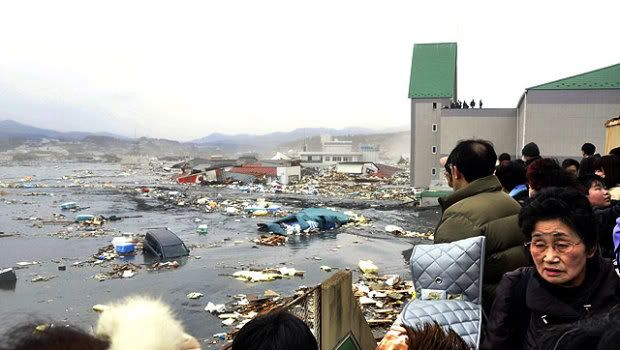
While browsing through the TV channels (it is a man's thing that women might not understand, what would we do without remote controls?), I come across many cable news channels showing the rescue efforts in Japan at full force, in an orderly and 'cultured' manner. People are struggling with thirst and hunger but have so much trust and confidence in the authorities that they simply do as they are told. Some have their houses swept away by a tsunami, and others have missing relatives whose whereabouts are unknown, but they take everything in stride. Yes, sorrow and uncertainty are written all over their faces, but faith and hope are also evident. There is crying, yes, but I never saw anyone wailing or showing emotional distress on camera. Unlike the chaos following Hurricane Katrina in New Orleans, there is no looting!
This is far from what I am used to seeing on Makkal TV, which showcases daily occurrences and mishaps faced by the poor Indians in Tamil Nadu. Makkal TV (as the name suggests, 'People's TV') highlights social issues across Southern India. Almost daily, we witness extreme public displays of emotion by victims of floods, loss of loved ones, or robbery. There are women with unkempt, uncombed hair wailing loudly, heaving their chests, and making repetitive hand and head movements as if having an epileptic seizure or crying for attention arranged neatly in front of the camera. Such behaviour is not exclusive to people of Dravidian descent, as similar chaos can also be seen in footage from the Middle East. In fact, in wealthy Chinese families, the culture often employs paid mourners who cease lamenting once their time is up. I once watched a Cantonese film where mourners wailed even more when offered more money!
This is far from what I am used to seeing on Makkal TV, which showcases daily occurrences and mishaps faced by the poor Indians in Tamil Nadu. Makkal TV (as the name suggests, 'People's TV') highlights social issues across Southern India. Almost daily, we witness extreme public displays of emotion by victims of floods, loss of loved ones, or robbery. There are women with unkempt, uncombed hair wailing loudly, heaving their chests, and making repetitive hand and head movements as if having an epileptic seizure or crying for attention arranged neatly in front of the camera. Such behaviour is not exclusive to people of Dravidian descent, as similar chaos can also be seen in footage from the Middle East. In fact, in wealthy Chinese families, the culture often employs paid mourners who cease lamenting once their time is up. I once watched a Cantonese film where mourners wailed even more when offered more money!
When societies evolve and affluence sets in, behaviours change. In Japan, citizens have an unshakable belief that their leaders will do all in their power to do what is best for their people. This is just like how the subject stood behind Emperor Hirohito with undivided loyalty during World War II!


